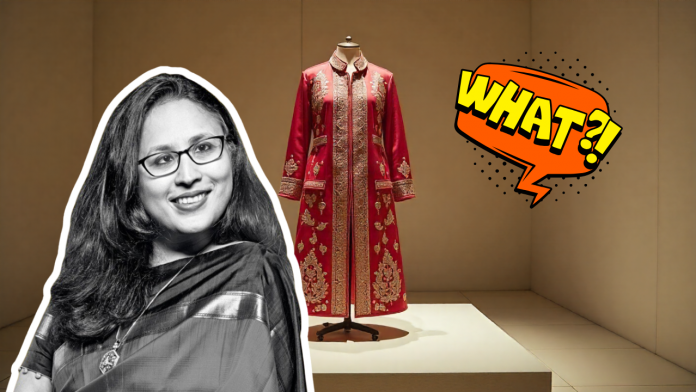
Edelweiss CEO and Shark Tank India judge Radhika Gupta has once again raised her voice against global fashion giants overlooking India’s rich artisanal legacy. This time, she’s taken aim at Dior for selling a coat worth $200,000 (₹1.7 crore) adorned with traditional Lucknowi Mukaish embroidery — without acknowledging the Indian artisans behind the craftsmanship.
Posting on X (formerly Twitter), Gupta called out the French luxury brand for what she sees as another instance of cultural erasure. The overcoat, which features delicate Mukaish work, was painstakingly made by a dozen Indian artisans over 34 days — yet there was no mention of India, no credit given, no context shared.
“One more handloom, one more headline,” she wrote. “Dior sells a $200K coat using Lucknowi Mukaish embroidery. 12 Indian artisans. 34 days of work. No credit. No context. No mention of India.”

Her frustration is clear, as she went on to say, “The world celebrates Indian craftsmanship, but rarely acknowledges the hands that create it. Branding and storytelling stay in the West — while our artisans remain invisible.”
Gupta used the moment to make a larger point about soft power, drawing comparisons to Japan’s global design influence and Korea’s pop culture dominance. “India needs to do the same with its craft. From being a sourcing hub, we must become a storytelling nation. A home to global brands. The lion has to come out. And roar.”
This isn’t Gupta’s first time calling out fashion labels for cultural appropriation. Not long ago, she criticized Prada for showcasing luxury sandals that looked strikingly similar to India’s Kolhapuri chappals — again, with no credit to the original artisans.

“₹500 chappals sold for ₹1 lakh — and not a word of acknowledgment,” she wrote in another viral post. “This is why I choose to wear and speak up about handlooms. Everyone knows Prada and Gucci. But hardly anyone in a room can name a Himroo, a Sambalpuri, or a Narayanpet weave.”
Gupta’s posts have sparked widespread conversation online, with many echoing her call for proper recognition of India’s diverse textile traditions. “Our craftsmanship is a treasure trove,” she wrote, “but unless we learn to tell our stories, the world will keep celebrating the hunter while the lion stays silent.”